Introduction
In modern industrial automation and precision machinery, ball screws are core components for achieving high-precision, high-efficiency linear motion. Understanding the basic knowledge of ball screws is crucial for engineering design, equipment selection, and maintenance management. This article will begin with the history of ball screws and provide a detailed introduction to their definition, structure, working principle, and types.

Development History of Ball Screws
Before the 19th Century
The earliest screw designs utilized the interaction of a screw and nut to convert rotational motion into linear motion. However, these traditional sliding screws used direct metal-to-metal contact, resulting in high friction, low efficiency, and severe wear, which long hindered the development of precision transmission.
Late 19th Century
The invention of ball bearings in the late 19th century revolutionized the mechanical industry. Engineers began to consider: could balls be introduced into the screw structure to reduce friction and improve efficiency? This idea laid the theoretical foundation for later ball screws.
Early 20th Century
The first truly modern ball screw was designed and implemented by German engineer Rudolph Gnutti in the early 20th century. He placed balls between the grooves of the screw and nut, allowing transmission through rolling rather than sliding, significantly improving smoothness and efficiency.
1940s
Due to their ability to provide highly accurate and reliable linear motion, ball screws were widely used in military equipment during World War II, such as in aircraft control systems and tank mechanisms.
1950s–1980s
After the war, ball screws rapidly expanded from military applications to civilian industries. Advances in precision machining, heat treatment, and materials science enabled ball screws to have higher load capacity, higher precision, and longer lifespan.
1990s to Present
With the increasing demand for miniature, high-precision components in industries such as electronics, medical devices, and aerospace, miniature ball screws emerged, providing precise motion in extremely limited spaces.
21st Century
With the rapid development of CNC systems, servo motors, and automated manufacturing, ball screws have become deeply integrated with electronic control systems. Today, they are key components in advanced manufacturing fields such as CNC machine tools, robots, 3D printers, and semiconductor equipment.
Definition of Ball Screw
A ball screw is a mechanical component that efficiently converts rotational motion into linear motion by using circulating balls rolling between the screw shaft and the nut. Its low-friction characteristics make it widely used in precision machinery and automation equipment.
Structure of Ball Screw
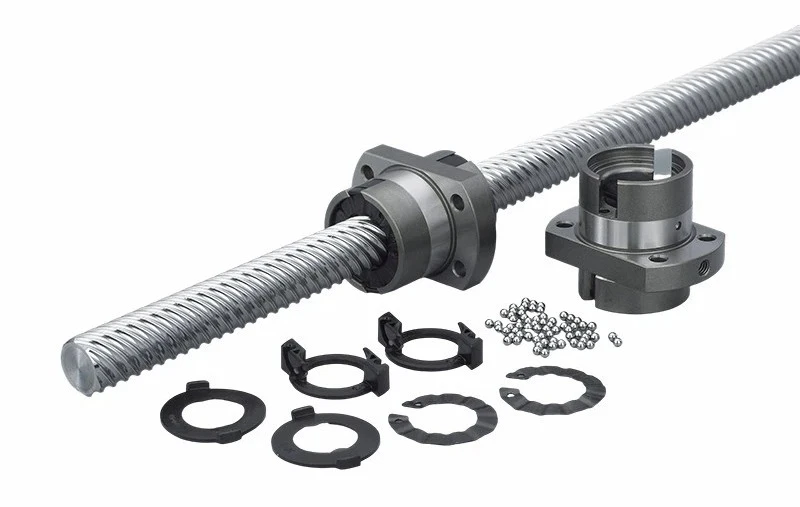
The components of a ball screw are as follows:
• Screw shaft: The core component that transmits rotational motion.
• Ball nut: Contains circulating balls to achieve smooth linear motion.
• Balls: Roll in the threads of the nut and screw shaft, reducing friction.
• Recirculation mechanism: Ensures the balls circulate within the nut, enabling backlash-free movement.
• Wiper and sealing device: Prevents dust and impurities from entering, ensuring long-term smooth operation.
Working Principle of Ball Screw
When the screw or nut rotates, the balls roll along the internal thread grooves of the nut, significantly reducing friction. The balls travel along a continuous return path, circulating back to the starting point, ensuring smooth and precise linear motion. The direction of motion depends on the rotation direction of the screw.
Types of Ball Screws
Ball screws can be classified into various types based on their circulation method, each type having different characteristics and applications:
|
Type |
Features |
Applications |
|
Single-start Ball Screw |
Single-row balls, simple structure |
Low-speed, high-precision transmission |
|
Multi-start Ball Screw |
Multiple rows of balls, higher load capacity |
High-load, high-speed motion equipment |
|
External Circulation Ball Screw |
Balls return through an external path |
Long-travel, high-precision machinery |
|
Internal Circulation Ball Screw |
Balls return through an internal path |
Space-constrained, compact equipment |
Ball Screw vs. Lead Screw
Both lead screws and ball screws convert rotational motion into linear motion, but they operate on significantly different principles. Lead screws achieve linear motion through direct sliding contact between the threads, while ball screws transmit power through the circulating motion of balls between the screw and the nut. This is their core difference, and consequently, they differ in various key performance characteristics.
|
Dimension |
Ball Screw |
Lead Screw |
|
Efficiency |
High (up to 90% or more) |
Low (50–60%) |
|
Precision |
High-precision positioning |
Precision affected by friction |
|
Load Capacity |
Can handle high loads |
Medium to low load capacity |
|
Service Life |
Long, wear-resistant |
Wears quickly, shorter life |
|
Energy Consumption |
Low |
High |
Conclusion
Understanding the history, definition, structure, working principle, and classification of ball screws helps engineers and purchasing personnel make more informed decisions when selecting linear motion components. Compared to traditional trapezoidal lead screws, ball screws offer higher efficiency, greater precision, longer service life, and significantly reduced energy consumption, making them widely used in modern high-precision equipment.
If your project requires high precision, high efficiency, and long-term reliability, choosing the right ball screw is crucial. JSM welcomes you to contact us for further information on technical parameters or selection advice, and let us help you find the most suitable ball screw solution for your equipment.