Introduction
Linear guide rails are essential for achieving smooth and precise motion in machinery. However, with several types available, each suited to different needs, choosing the right one can be challenging. This article breaks down the main types of linear guide rails and how to select the best option for your application.
Main Types of Linear Guide Rails
Ball Bearing Linear Guide Rails
They use recirculating steel balls to reduce friction and provide exact linear motion. They are suitable for applications requiring high speed and precision, such as CNC machinery, robotics, and 3C electronics assembly.

Roller Type Linear Guide Rails
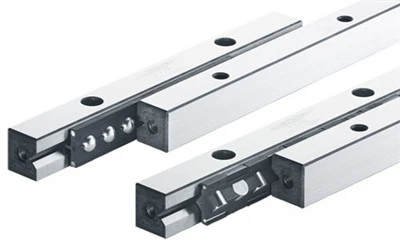
Roller linear guide rails use cylindrical rollers instead of balls, providing higher rigidity and load capacity. They perform exceptionally well in heavy-duty applications and environments requiring impact resistance, making them a preferred choice in industries like automotive manufacturing and metal processing.

Miniature Linear Guide Rails
Designed for compact systems, miniature linear guides are lightweight, space-saving, and highly accurate. They are widely used in small-scale automation, medical instruments, and laboratory equipment. Despite their size, they deliver smooth motion and excellent repeatability.

Sliding Linear Guides
Sliding linear guides use smooth surface contact to achieve linear motion and are often used in applications where space is limited and high precision is required, such as electronic equipment, optical instruments, and small positioning systems. Though friction is higher than ball or roller guides, they offer stable, accurate motion in limited spaces.

How to Choose the Right Linear Guide for Your Application
When selecting a linear guide, consider these key factors:
• Load Capacity
Choose a guide rail that can withstand the maximum loads and forces in your equipment. For example, roller guides offer a more robust structure and are suitable for heavier loads, while miniature guides are lightweight and suitable for lighter systems.
• Precision Requirements
If your application requires high-precision motion, it is recommended to choose ball bearings or sliding guides with closer tolerances, as they provide more stable and precise linear movement.
• Operating Speed
Consider the required speed of movement in your application. Ball bearing guides are ideal for high-speed operations due to their low friction, while sliding guides are better suited for slower, controlled motion.
• Space Constraints
If the equipment installation space is limited, compact sliding or miniature guides are suitable. These rails are small in size and suitable for space-constrained scenarios.
• Environmental Conditions
Consider whether the guide will be exposed to dust, moisture, or chemicals; roller guides often have better durability and sealing to withstand harsher conditions.
Conclusion
Linear guide rails come in various types, each engineered for specific mechanical and environmental demands. By selecting the right guide rail, you can enhance your equipment's accuracy, efficiency, and lifespan.
JSM: High-Quality Linear Guide Manufacturer
As a specialized manufacturer, JSM offers a wide range of linear guide rails, including miniature, roller, and other customized types to meet diverse application needs. Contact us today to explore reliable, precision-engineered linear guide solutions.