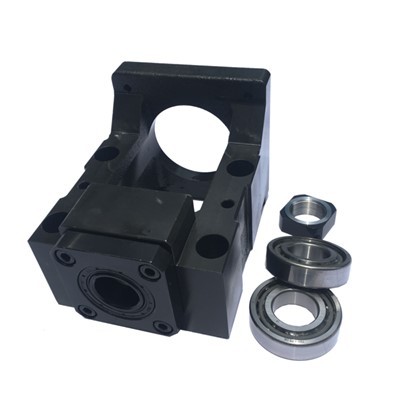
In the realm of precision motion control, zero backlash ball screws play a pivotal role. As a dedicated supplier of zero backlash ball screws, I am thrilled to delve into the concept of the pitch of these remarkable mechanical components.
Understanding the Basics of Ball Screws
Before we specifically discuss the pitch of zero backlash ball screws, let's first have a brief overview of ball screws in general. A ball screw is a mechanical device used to convert rotational motion into linear motion or vice versa with high efficiency. It consists of a screw shaft, a nut, and a series of balls that roll between the screw and the nut. This rolling action significantly reduces friction compared to traditional lead screws, resulting in smoother and more precise motion.
There are different types of ball screws available in the market, such as Recirculating Ball Screw, Double Nut Ball Screw, and High Speed Ball Screw. Each type has its own unique features and applications, but they all share the fundamental principle of using balls to facilitate motion transfer.
Defining the Pitch of a Ball Screw
The pitch of a ball screw is defined as the distance that the nut travels along the screw shaft in one complete rotation of the screw. It is a crucial parameter that directly affects the performance and functionality of the ball screw system. Mathematically, the pitch is measured in millimeters (mm) or inches (in), depending on the unit system used.
For example, if a ball screw has a pitch of 5 mm, it means that for every full rotation of the screw shaft, the nut will move precisely 5 mm along the shaft. This relationship between rotation and linear displacement is what makes ball screws so accurate and reliable for applications that require precise positioning.
Importance of Pitch in Zero Backlash Ball Screws
In the context of zero backlash ball screws, the pitch becomes even more significant. Zero backlash ball screws are designed to eliminate any play or clearance between the screw and the nut, ensuring that there is no lost motion when the direction of rotation is reversed. This is achieved through various design techniques, such as preloading the balls or using a special nut configuration.
The pitch of a zero backlash ball screw determines the resolution and speed of the linear motion. A smaller pitch provides higher resolution, which means that the system can achieve finer positioning accuracy. On the other hand, a larger pitch allows for faster linear travel but may sacrifice some precision. Therefore, selecting the appropriate pitch is a critical decision that depends on the specific requirements of the application.
Applications and Pitch Selection
The choice of pitch for a zero backlash ball screw is highly dependent on the application. Let's explore some common applications and the pitch considerations for each:
Machine Tools
In machine tools, such as CNC milling machines and lathes, high precision is of utmost importance. These machines require accurate positioning of the cutting tool to achieve the desired machining tolerances. For such applications, a smaller pitch, typically in the range of 2 - 5 mm, is often preferred. This allows for precise control of the tool's movement, resulting in high - quality machining operations.
Robotics
Robots need to perform various tasks with speed and accuracy. The pitch selection for zero backlash ball screws in robotics depends on the specific requirements of the robot's movement. For tasks that require fine manipulation, such as pick - and - place operations in electronics manufacturing, a smaller pitch may be chosen to ensure precise positioning. However, for applications where speed is more critical, such as in some industrial robots that need to cover large distances quickly, a larger pitch can be used.
Semiconductor Manufacturing
Semiconductor manufacturing processes demand extremely high precision and repeatability. In this industry, zero backlash ball screws with very small pitches, sometimes as low as 1 mm or even less, are commonly used. These small - pitch ball screws enable the precise movement of wafers and other components during processes like lithography and wafer inspection, ensuring the quality and yield of semiconductor devices.
Factors Affecting Pitch Performance
Several factors can affect the performance of the pitch in a zero backlash ball screw system. One of the key factors is the lead accuracy. Lead accuracy refers to how closely the actual linear displacement of the nut matches the theoretical displacement based on the pitch. Any deviation from the ideal pitch can result in positioning errors, especially in applications that require high precision.
Another factor is the dynamic load capacity. As the pitch increases, the load - carrying capacity of the ball screw may be affected. A larger pitch may lead to higher forces acting on the balls and the screw shaft, which can potentially reduce the service life of the ball screw if the load exceeds its rated capacity. Therefore, it is essential to consider the dynamic load requirements of the application when selecting the pitch.
Compromises and Trade - offs
When choosing the pitch for a zero backlash ball screw, there are always compromises and trade - offs to be made. As mentioned earlier, a smaller pitch offers higher resolution but slower linear speed, while a larger pitch provides faster travel but lower resolution. Additionally, smaller - pitch ball screws may be more expensive due to the higher manufacturing precision required.
Engineers and designers need to carefully evaluate the specific requirements of the application, such as the required positioning accuracy, speed, load capacity, and cost constraints, to make an informed decision about the pitch. In some cases, it may be necessary to strike a balance between different factors to achieve the optimal performance of the ball screw system.
Conclusion and Call to Action
In conclusion, the pitch of a zero backlash ball screw is a fundamental parameter that significantly impacts the performance and suitability of the ball screw for various applications. Understanding the concept of pitch and its implications is essential for anyone involved in the design, selection, or use of zero backlash ball screw systems.
As a supplier of zero backlash ball screws, we offer a wide range of products with different pitches to meet the diverse needs of our customers. Whether you are working on a high - precision machine tool, a fast - moving robot, or a semiconductor manufacturing process, we have the expertise and the products to provide you with the right solution.
If you are interested in learning more about our zero backlash ball screws or would like to discuss your specific application requirements, we encourage you to reach out to us. Our team of experts is ready to assist you in selecting the most appropriate pitch and ball screw configuration for your project. Let's work together to achieve the highest level of precision and performance in your motion control applications.


References
- Budynas, R. G., & Nisbett, J. K. (2011). Shigley's Mechanical Engineering Design. McGraw - Hill.
- Spotts, M. F., Shoup, T. E., & Taborek, P. (2004). Design of Machine Elements. Prentice Hall.