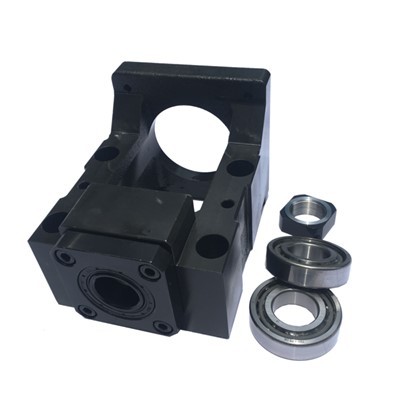
Hey there! As a supplier of Double Nut Ball Screws, I often get asked about when it's the right time to use a precision double nut ball screw. Well, let's dive right into it and explore the scenarios where these bad boys really shine.
First off, let's understand what a double nut ball screw is. It's a type of ball screw that has two nuts on the screw shaft. These nuts are pre - loaded against each other, which helps eliminate backlash. Backlash is the play or clearance between the screw and the nut, and it can cause inaccuracies in positioning. So, a double nut ball screw is all about precision.
High - Precision Positioning Applications
One of the most common situations where you'd want to use a precision double nut ball screw is in high - precision positioning applications. Think about CNC machines. These machines need to move with extreme accuracy to cut, drill, or mill parts to exact specifications. Whether it's a small hobbyist CNC router or a large industrial machining center, the precision of a double nut ball screw can make a huge difference.
For example, in a CNC lathe, the cutting tool needs to be positioned precisely to create smooth and accurate surfaces on the workpiece. A double nut ball screw ensures that there's no lost motion due to backlash, so the tool moves exactly where it's supposed to. This results in higher quality parts and less waste. If you're interested in smaller options for such applications, you can check out our Small Ball Screw and Small Nut Ball Screw offerings.


Robotic Systems
Robots are another area where precision double nut ball screws are a must - have. Robots are used in a wide range of industries, from automotive manufacturing to food packaging. In these applications, robots need to pick, place, and manipulate objects with great accuracy.
Let's say you have a robotic arm in an assembly line. It needs to pick up a small component and place it exactly in the right position on a larger part. A double nut ball screw in the joints of the robotic arm allows for precise control of the movement. This means fewer errors in the assembly process and higher productivity. The pre - loading of the double nuts ensures that the arm moves smoothly and consistently, even under heavy loads.
Medical Equipment
Medical equipment also benefits greatly from the use of precision double nut ball screws. Take MRI machines, for example. These machines need to move the patient table with extreme precision to get clear and accurate images. Any small movement error could result in blurry images, which could lead to misdiagnosis.
A double nut ball screw provides the necessary precision for the table movement. It can move the table slowly and steadily, and maintain its position accurately during the scanning process. Similarly, in surgical robots, precision is of the utmost importance. The robotic arms need to be able to move with sub - millimeter accuracy to perform delicate surgeries. Double nut ball screws help achieve this level of precision, improving patient outcomes.
High - Load Applications
Double nut ball screws are also a great choice for high - load applications. When you have a heavy load that needs to be moved or supported, a single nut ball screw might not be up to the task. The double nut design distributes the load more evenly between the two nuts, reducing the stress on each nut and increasing the overall load - carrying capacity.
For instance, in a large press machine, where tons of force are applied to shape metal parts, a double nut ball screw can handle the high loads without deforming or wearing out quickly. It ensures that the press moves smoothly and precisely, even under the immense pressure. This not only improves the quality of the parts being produced but also extends the lifespan of the equipment.
Long - Stroke Applications
In applications where the screw needs to travel a long distance, a precision double nut ball screw is a smart choice. Long - stroke applications can be found in things like large gantry systems or linear actuators used in construction equipment.
The double nut design helps maintain the accuracy of the movement over the entire stroke length. As the screw moves, the pre - loaded nuts keep the motion smooth and free of backlash. This is important because even a small amount of backlash can accumulate over a long distance, leading to significant positioning errors.
Factors to Consider
Before deciding to use a precision double nut ball screw, there are a few factors you should consider. First, cost. Double nut ball screws are generally more expensive than single nut ball screws. This is because of the additional manufacturing processes and the use of two nuts. However, if precision is critical for your application, the extra cost is often worth it.
Another factor is the space available. Double nut ball screws are typically longer than single nut ball screws because of the two nuts. You need to make sure you have enough space in your machine or equipment to accommodate them.
Also, consider the speed requirements of your application. Double nut ball screws can handle high speeds, but you need to ensure that the screw and nut materials are suitable for the speed at which they'll be operating.
Conclusion
So, to sum it up, a precision double nut ball screw should be used in high - precision positioning applications, robotic systems, medical equipment, high - load applications, and long - stroke applications. It offers excellent accuracy, load - carrying capacity, and smooth operation.
If you're in the market for a double nut ball screw, we've got you covered. Check out our Double Nut Ball Screw options. We offer a wide range of sizes and specifications to meet your specific needs. Whether you're a small business or a large industrial manufacturer, we can provide the right solution for you.
If you have any questions or want to discuss your requirements in more detail, don't hesitate to reach out. We're here to help you make the best choice for your application. Let's work together to get the precision and performance you need!
References
- "Ball Screw Handbook" by Thomson Industries
- "Precision Linear Motion Technology" by Bosch Rexroth