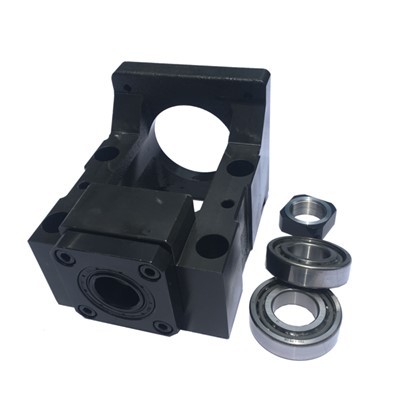
Hey there! As a supplier of Ball Screw Bearing Blocks, I've seen firsthand how axial clearance can play a huge role in the performance of these components. So, let's dive right in and talk about what effects axial clearance can have on the performance of a ball screw bearing block.
What is Axial Clearance?
First off, let's quickly define axial clearance. Axial clearance is the amount of free movement that a bearing has in the axial direction, which is parallel to the axis of rotation. In simple terms, it's the wiggle room a bearing has back and forth along the shaft.
Axial clearance can be either positive or negative. Positive axial clearance means there's some space between the bearing components, allowing for a bit of movement. Negative axial clearance, on the other hand, means the bearing components are pre - loaded, and there's no free play.
Effects on Precision
One of the most significant effects of axial clearance is on the precision of the ball screw bearing block. When you're using a ball screw in a precision application, like a CNC machine or a robotic arm, you need accurate positioning.


If the axial clearance is too large (positive), the ball screw may experience some backlash. Backlash is the play or movement in the system when the direction of motion changes. This can lead to errors in positioning, as the screw has to “take up” the slack before it can start moving in the new direction. For example, if you're trying to move a cutting tool to a specific position on a workpiece, the extra movement due to backlash can result in a cut that's off by a few thousandths of an inch, which can be a big deal in high - precision manufacturing.
On the flip side, if the axial clearance is negative (pre - loaded), the bearing can provide very high precision. The pre - load eliminates the backlash, allowing for smooth and accurate motion. However, too much pre - load can also cause problems, which we'll discuss later.
Effects on Load Capacity
Axial clearance also affects the load - carrying capacity of the ball screw bearing block. A bearing with some positive axial clearance can handle dynamic loads better in certain situations. When a load is applied, the bearing can “give” a little, which helps to distribute the load more evenly across the balls and the raceways. This can prevent premature wear and failure of the bearing.
But if the axial clearance is too large, the bearing may not be able to handle the load properly. The extra movement can cause the balls to shift and move out of their optimal positions, leading to uneven loading and increased stress on the bearing components. This can result in reduced load capacity and a shorter service life.
In contrast, a pre - loaded bearing (negative axial clearance) can have a higher static load capacity. The pre - load keeps the balls in a more stable position, allowing the bearing to better withstand a stationary load. However, when it comes to dynamic loads, a pre - loaded bearing may be more prone to fatigue because the constant stress on the pre - loaded components can lead to cracks and other forms of damage over time.
Effects on Noise and Vibration
Another aspect to consider is the impact of axial clearance on noise and vibration. A bearing with excessive positive axial clearance can produce more noise and vibration during operation. The extra movement of the balls and the components can cause them to rattle and bang against each other, creating an audible noise. This can be a nuisance in a factory environment, and it can also be an indication of a problem with the bearing.
Vibration is also a concern. Excessive vibration can affect the performance of the entire system. It can cause the ball screw to wear out faster, and it can also lead to problems with the accuracy of the machine. For example, in a 3D printer, vibration can cause the printed object to have a rough surface or even be distorted.
A pre - loaded bearing, on the other hand, tends to be quieter and have less vibration because there's no free play. The components are held tightly together, which reduces the chances of rattling and vibration.
Effects on Temperature
Axial clearance can also influence the temperature of the ball screw bearing block. When a bearing has a large positive axial clearance, the balls and the raceways may not make proper contact. This can lead to increased friction, which in turn generates heat. High temperatures can be a problem because they can cause the lubricant in the bearing to break down, reducing its effectiveness. It can also cause the bearing materials to expand, which can change the axial clearance and other operating characteristics of the bearing.
In a pre - loaded bearing, the contact between the balls and the raceways is more consistent. This generally results in lower friction and less heat generation. However, if the pre - load is too high, it can also cause excessive friction and heat, as the components are being forced together too tightly.
Finding the Right Axial Clearance
As you can see, finding the right axial clearance is crucial for the optimal performance of a ball screw bearing block. It depends on several factors, such as the application, the load conditions, and the required precision.
For high - precision applications, a pre - loaded bearing with a small negative axial clearance is often the best choice. This ensures accurate positioning and low backlash. However, you need to be careful not to over - pre - load the bearing, as this can lead to premature failure.
For applications where there are dynamic loads and some tolerance for backlash is acceptable, a bearing with a small positive axial clearance may be more suitable. This allows the bearing to handle the loads better and can extend its service life.
Our Products and How They Fit In
At our company, we offer a wide range of Ball Screw Bearing Blocks with different axial clearances to meet various application requirements. Whether you need a high - precision pre - loaded bearing for a CNC machine or a bearing with a bit of axial clearance for a less demanding application, we've got you covered.
We also provide Servo Motor Brackets and Ball Screw Linear Bearing Seats that are designed to work seamlessly with our ball screw bearing blocks. These components are engineered to ensure the best performance and reliability of your ball screw system.
Conclusion and Call to Action
In conclusion, axial clearance has a profound impact on the performance of a ball screw bearing block. It affects precision, load capacity, noise, vibration, and temperature. By choosing the right axial clearance for your application, you can ensure that your ball screw system operates smoothly and efficiently.
If you're in the market for ball screw bearing blocks or related components, we'd love to talk to you. We have a team of experts who can help you select the right products based on your specific needs. Whether you're a small - scale manufacturer or a large industrial company, we're here to provide you with high - quality products and excellent customer service. So, don't hesitate to reach out and start a conversation about your procurement needs.
References
- Harris, T. A., & Kotzalas, M. N. (2007). Rolling Bearing Analysis. Wiley.
- Stachowiak, G. W., & Batchelor, A. W. (2005). Engineering Tribology. Elsevier.