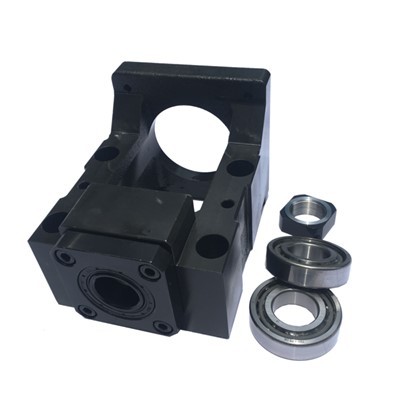
Calculating the load capacity of a ball screw fixed side is a crucial aspect in the field of mechanical engineering, especially when it comes to precision machinery and automation systems. As a supplier of Ball Screw Fixed Side components, I understand the significance of accurate load capacity calculations. This blog will guide you through the process, providing insights into the key factors and methods involved.


Understanding the Basics of Ball Screw Fixed Side
Before delving into load capacity calculations, it's essential to have a clear understanding of what a ball screw fixed side is. The fixed side of a ball screw is responsible for supporting the axial load and ensuring the precise positioning of the screw shaft. It typically consists of a bearing block, which houses the bearings that support the screw shaft, and a mounting bracket that attaches the bearing block to the machine frame.
The main components of a ball screw fixed side include:
- Ball Screw Bearing Block: This component provides the support for the ball screw shaft. It contains the bearings that allow the shaft to rotate smoothly while carrying the axial and radial loads. You can find more information about our Ball Screw Bearing Block.
- Servo Motor Mounting Bracket: The servo motor mounting bracket is used to attach the servo motor to the ball screw system. It ensures proper alignment and transmission of power from the motor to the ball screw. Check out our Servo Motor Mounting Bracket.
- Servo Motor Seat: The servo motor seat provides a stable base for the servo motor. It helps to reduce vibrations and ensure the efficient operation of the motor. Learn more about our Servo Motor Seat.
Factors Affecting the Load Capacity of a Ball Screw Fixed Side
Several factors influence the load capacity of a ball screw fixed side. Understanding these factors is essential for accurate calculations.
- Axial Load: The axial load is the force applied along the axis of the ball screw. It is one of the primary factors determining the load capacity of the fixed side. The axial load can be static or dynamic, depending on the application. Static axial loads are constant, while dynamic axial loads vary over time.
- Radial Load: The radial load is the force applied perpendicular to the axis of the ball screw. Although the ball screw is primarily designed to handle axial loads, it may also be subjected to radial loads in some applications. The radial load capacity of the fixed side should be considered to ensure its proper functioning.
- Speed and Acceleration: The speed and acceleration of the ball screw system affect the load capacity of the fixed side. Higher speeds and accelerations result in increased forces and stresses on the components, which can reduce the load capacity. It is important to consider the operating speed and acceleration when calculating the load capacity.
- Lubrication: Proper lubrication is crucial for the performance and longevity of the ball screw fixed side. Lubrication reduces friction and wear, which can increase the load capacity. The type and amount of lubricant used should be selected based on the application requirements.
- Temperature: The operating temperature of the ball screw system can also affect the load capacity of the fixed side. High temperatures can cause the lubricant to break down and reduce its effectiveness, leading to increased friction and wear. It is important to consider the temperature range of the application and select components that can withstand the operating temperatures.
Methods for Calculating the Load Capacity of a Ball Screw Fixed Side
There are several methods for calculating the load capacity of a ball screw fixed side. The most common methods are based on the ISO standards and the manufacturer's specifications.
- ISO Standards: The International Organization for Standardization (ISO) has developed standards for calculating the load capacity of rolling bearings, which are used in ball screw fixed sides. These standards provide guidelines for determining the basic dynamic load rating (C) and the basic static load rating (Co) of the bearings. The basic dynamic load rating is the load that a bearing can withstand for a specified number of revolutions with a 90% probability of survival. The basic static load rating is the maximum static load that a bearing can withstand without permanent deformation.
- Manufacturer's Specifications: The manufacturer of the ball screw fixed side usually provides load capacity data in their product catalogs. These data are based on the results of tests and calculations performed by the manufacturer. It is important to refer to the manufacturer's specifications when calculating the load capacity to ensure the accuracy of the results.
- Finite Element Analysis (FEA): Finite Element Analysis is a numerical method for analyzing the behavior of structures and components under different loading conditions. FEA can be used to calculate the stress and deformation of the ball screw fixed side components, which can help to determine their load capacity. FEA is a more advanced and accurate method, but it requires specialized software and expertise.
Step-by-Step Guide for Calculating the Load Capacity of a Ball Screw Fixed Side
The following is a step-by-step guide for calculating the load capacity of a ball screw fixed side using the ISO standards:
- Determine the Axial and Radial Loads: The first step is to determine the axial and radial loads acting on the ball screw fixed side. These loads can be calculated based on the application requirements and the forces acting on the ball screw system.
- Select the Appropriate Bearings: Based on the axial and radial loads, select the appropriate bearings for the ball screw fixed side. The bearings should have a basic dynamic load rating (C) and a basic static load rating (Co) that are greater than the calculated loads.
- Calculate the Equivalent Dynamic Load: The equivalent dynamic load (P) is a single load that represents the combined effect of the axial and radial loads on the bearings. The equivalent dynamic load can be calculated using the following formula:
- For ball bearings: (P = XFr + YFa)
- For roller bearings: (P = 0.6Fr + 0.4Fa)
where (Fr) is the radial load, (Fa) is the axial load, (X) and (Y) are the radial and axial load factors, respectively. The values of (X) and (Y) depend on the type of bearing and the ratio of the axial load to the radial load.
- Calculate the Basic Dynamic Load Rating: The basic dynamic load rating (C) of the bearings can be calculated using the following formula:
- (C = P(\frac{L_{10}}{10^6})^{\frac{1}{p}})
where (L_{10}) is the rated life of the bearings in revolutions, and (p) is the exponent, which is 3 for ball bearings and (\frac{10}{3}) for roller bearings.
- (C = P(\frac{L_{10}}{10^6})^{\frac{1}{p}})
- Check the Static Load Capacity: The static load capacity of the bearings should also be checked to ensure that they can withstand the maximum static load without permanent deformation. The static load capacity can be calculated using the following formula:
- (P_0 = X_0Fr + Y_0Fa)
where (P_0) is the equivalent static load, (X_0) and (Y_0) are the static radial and axial load factors, respectively.
- (P_0 = X_0Fr + Y_0Fa)
- Verify the Results: Once the load capacity calculations are completed, it is important to verify the results by comparing them with the manufacturer's specifications and the application requirements. If the calculated load capacity is less than the required load capacity, it may be necessary to select larger bearings or modify the design of the ball screw fixed side.
Importance of Accurate Load Capacity Calculations
Accurate load capacity calculations are essential for the proper design and operation of the ball screw fixed side. Incorrect load capacity calculations can lead to premature failure of the components, which can result in downtime, increased maintenance costs, and reduced productivity. By ensuring that the load capacity of the fixed side is sufficient for the application requirements, you can improve the reliability and performance of the ball screw system.
Conclusion
Calculating the load capacity of a ball screw fixed side is a complex process that requires a thorough understanding of the factors affecting the load capacity and the methods for calculating it. As a supplier of Ball Screw Fixed Side components, we can provide you with the necessary information and support to help you calculate the load capacity accurately. If you have any questions or need assistance with your ball screw fixed side application, please feel free to contact us for procurement and further discussions.
References
- ISO 281:2007, Rolling bearings - Dynamic load ratings and rating life
- Manufacturer's product catalogs for ball screw fixed side components